The validation chain
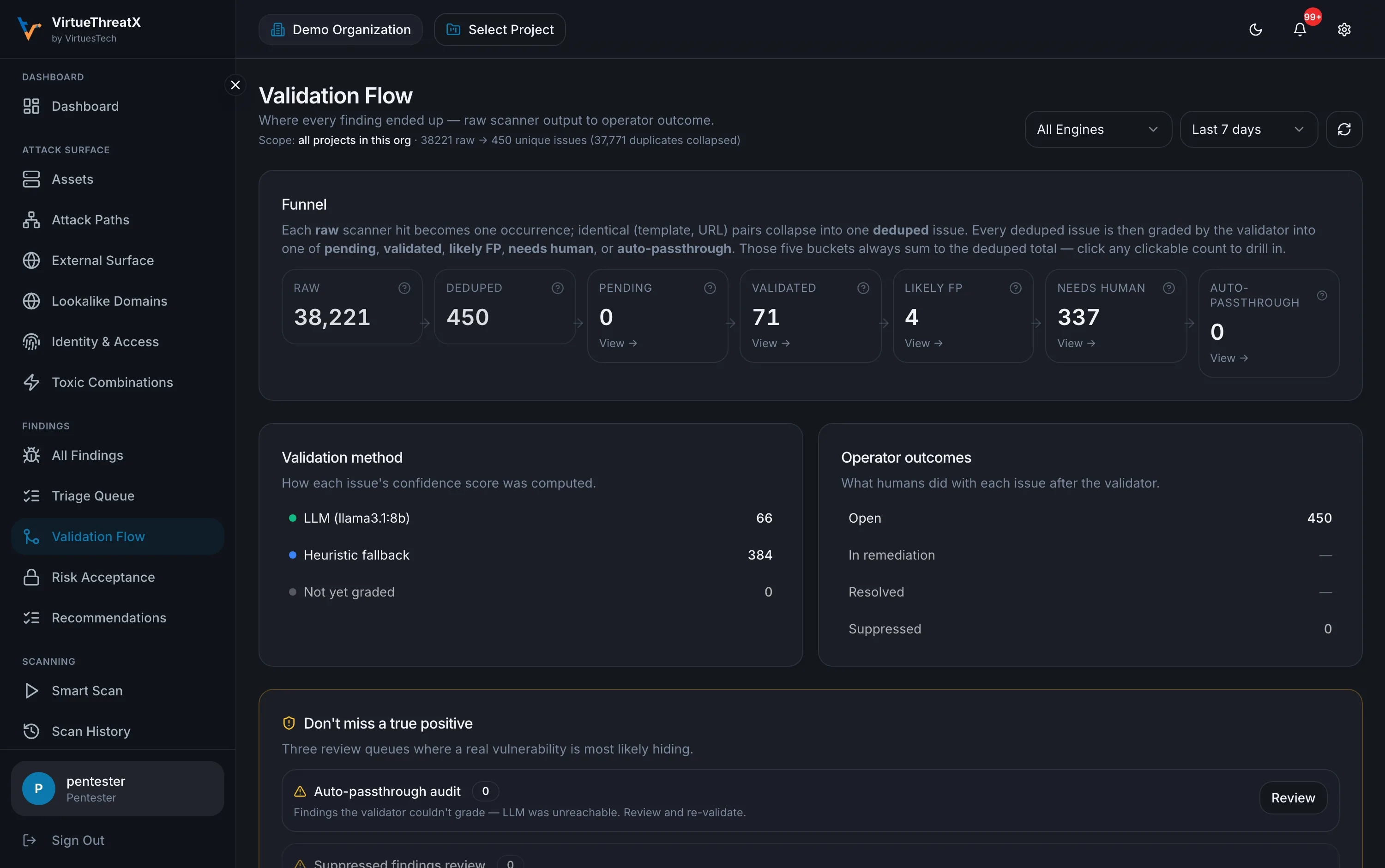
Every finding earns its label: detected → corroborated across multiple engines → adversarially probed → assigned a state. Severity is evidence, not an estimate.
Platforms / Continuous Threat Exposure Management
Scanners produce lists; attackers produce proof. VirtueThreatX runs all five Gartner CTEM stages in one workflow — with adversarial validation and AI/LLM exposure built in — so your team ships proven, prioritized fixes instead of more findings.
Detection is the start, not the answer. A finding is corroborated across engines, adversarially probed, then assigned one of four honest states — so only proven-exploitable exposures reach your team.
A candidate finding enters the pipeline.
Cross-engine agreement separates signal from noise.
A production-safe probe proves exploitability.
The finding earns one of four honest states.
Only one state wakes your team
Validated
Proven exploitable — pages on-call with evidence
Validating
In active adversarial probe
Theoretical
Real, but not reachable
Suppressed
Audit trail only
01
Define the estate that matters — the assets, apps, and surfaces where exposure actually carries business risk.
02
Seedless external attack-surface discovery finds every asset, subdomain, certificate, and shadow service exposed to the internet.
03
Rank by real risk — KEV status, EPSS, and business context — not by raw CVSS severity.
04
Adversarial, production-safe probing proves what is actually exploitable — the stage most platforms skip.
05
Validated exposures open tickets with an owner and SLA, trigger response, and are tracked to a proven fix. Then the loop starts again.
Every finding earns its label: detected → corroborated across multiple engines → adversarially probed → assigned a state. Severity is evidence, not an estimate.
Validated (proven exploitable — pages on-call with evidence), Validating (in active probe), Theoretical (real but not reachable), Suppressed (audit trail only). Only Validated wakes your team.
The right scanner is dispatched to the right surface — Web, API, Cloud, Identity, AI/LLM — not blasted across every asset. Higher signal, lower cost — scans dispatched only where they apply.
Prompt-injection probing, RAG context fuzzing, shadow-AI discovery, and model-exposure scanning. The attack surface most exposure tools don't cover at all.
Re-scans fire on the events that actually change risk — code pushes, new KEV entries, certificate-transparency logs, cloud changes — so you see what's new, not the whole report every time.
Over-permissioned roles, leaked credentials, non-human identity sprawl, and IAM relationship walks — the identity attack paths behind most modern breaches.
Architecture
One validation pipeline under every engine — detection, corroboration, and adversarial proof share the same evidence trail, not three tools stitched together at the reporting layer.
Discover
Seedless discovery maps everything internet-exposed — assets, subdomains, certificates, shadow services — and monitors it for drift.
Detect
Continuous, event-driven scanning across Web, API, Cloud, Identity, and AI/LLM surfaces — the right engine on the right target, corroborated across engines to separate signal from noise.
Validate
Production-safe adversarial probing (BAS) plus LLM triage and KEV cross-reference prove exploitability before a finding ever reaches your queue — the platform's defining step.
Mobilize
Validated exposures auto-open tickets with an owner and SLA, integrate with security operations, and are re-validated on change until proven fixed.
Runs as a continuous exposure-management service alongside our assessment engagements. Adversarial validation is production-safe by design; scope, scan cadence, and data handling are agreed at engagement start, and findings are tenant-isolated.
Per-tenant data isolation; data-handling terms committed in your service agreement. See Trust & Company Facts.
Real screens from a live demo tenant — not mockups. Client data is redacted; the interface and data model are exactly what your team works in.
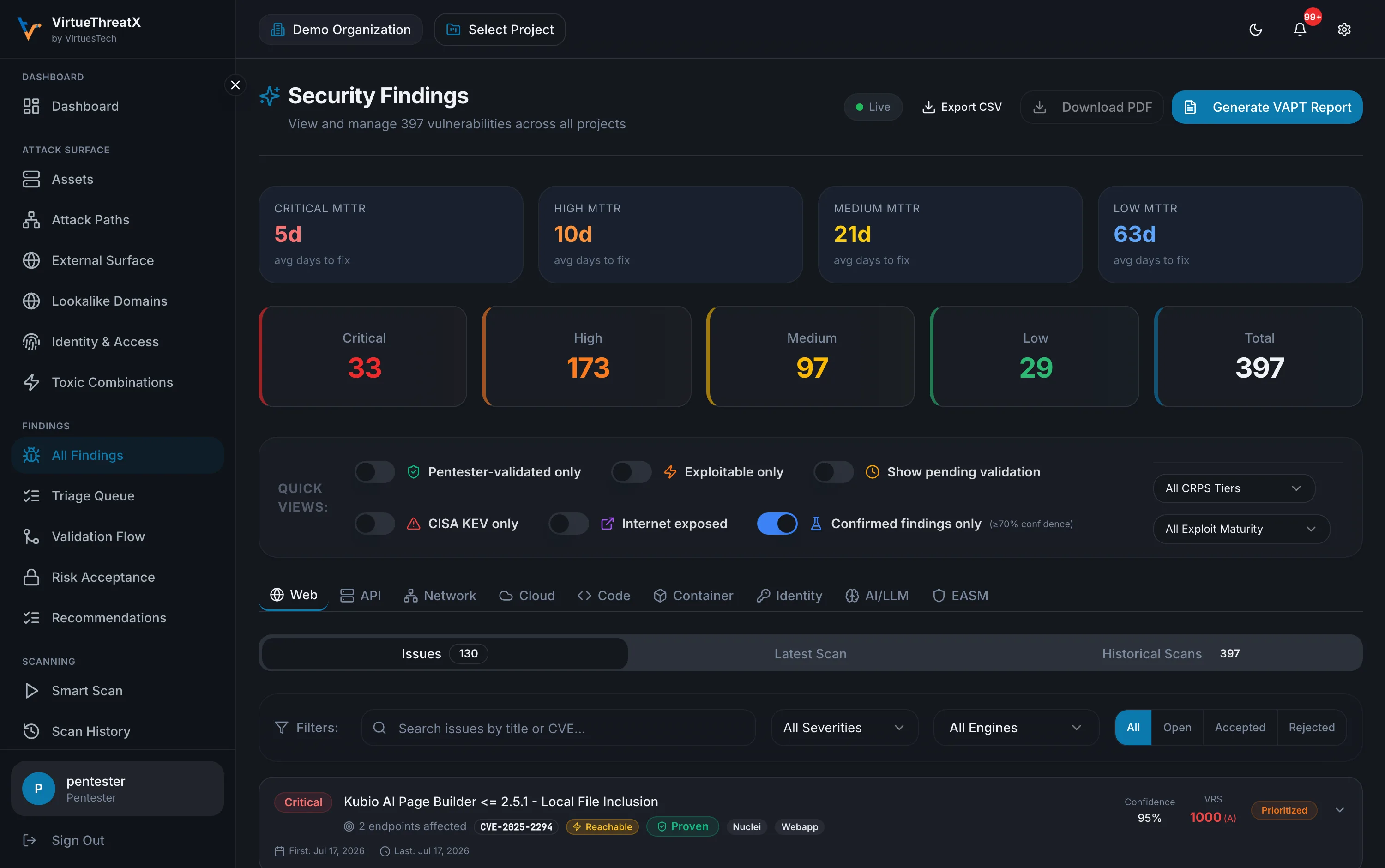
VirtueThreatX powers our vulnerability assessment and continuous testing engagements — and in the assurance loop it's the ATTACK phase's proving ground: findings our red team and pentesters confirm become validated, tracked exposures.
Vulnerability Assessment service →A guided walkthrough of the platform with the team that built it — on live data, with your questions answered in real time.